Department for Education · Design Leadership
Strengthening the attendance data service
The DfE Attendance Data Service had grown significantly in a short space of time during the pandemic, and now needed support to strengthen and scale its design and delivery. With a range of challenges to meet, I adapted and took on a range of roles to help the service strengthen and grow.
- Client
- Department for Education
- Design agency
- Hippo Digital
- Duration
- 14 months, 2025 to 2026
- My role
- Service designer, Power Apps developer, agile delivery coach, AI evangelist, user researcher
- Wider team make up
- User Researcher, Product Manager, Service Designer, Delivery Manager, Developers, Business Analyst, Content Designer and policy teams
- Methods and outputs
- Workshopping, user research, prototyping, AI vibe coding and app development, mapping, service blueprinting and service surveys
My impact
Before
The service had grown significantly in a short time, and needed to strengthen and scale its design and delivery, and coordinate work across a complex system of teams.
What I did
- Supported policy and leadership to further develop the strategy
- Provided guidance and coaching on scaled design, development and delivery
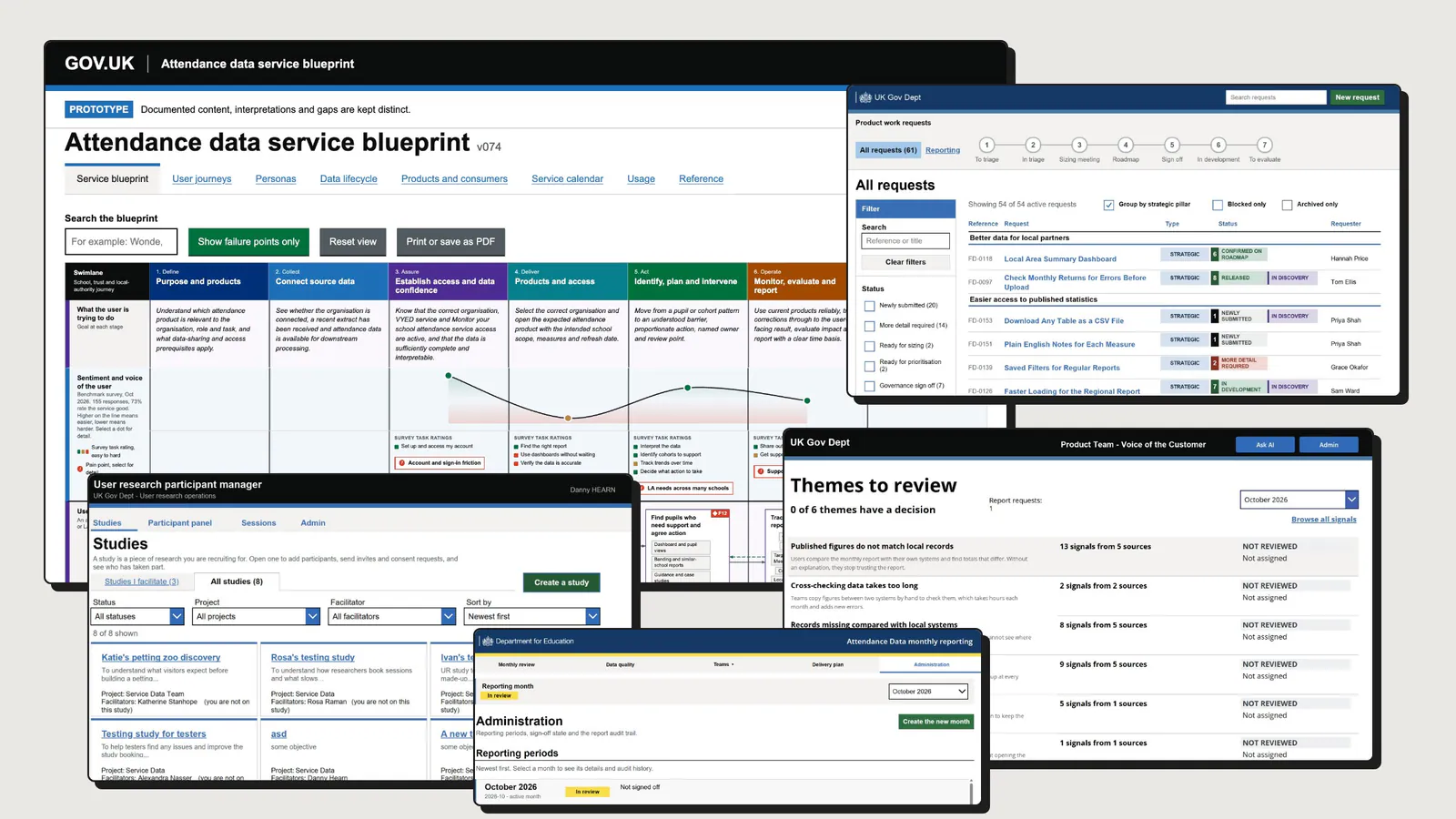
- Pioneered vibe coding and innovative uses of AI to build multiple Microsoft Power Apps for the team
- Ran a user satisfaction survey and established a research pool of 400+ participants
Results
- A shift in culture and capability
- Team regularly reviews a wide range of service user feedback
- Dramatic improvement in the clarity and focus of the team's understanding of its portfolio of projects and new work requests
- Inspired and created a cultural shift in DfE around vibe coding Microsoft Power Apps, adopting my agents, apps and methods
A team that had grown fast
The team had worked lean, without the full range of user-centred design roles, or a way of delivering features that drew on them.
Delivery was spread across several siloed teams, so it was hard to track and develop features in a consistent, clear way, grounded in user-centred design.
Supporting policy and leadership with the strategy
- Ran a workshop with senior leadership and policy leads to develop and put the strategy into practice.
- Facilitated regular sessions where policy teams could reflect on the strategy and decide what to do about it.
- Set up a cadence and tracking, creating accountability and ownership for the actions.
- Advised the service owner on an ongoing basis.


Through a series of workshops I co-created a set of OKRs with the team, and a spreadsheet tracker to go with them. The aim was for the team to set its own targets and track them over time.


Creating a service vision
The service vision helped people reimagine how the service might look if it were organised around user journeys and workflows rather than features. I developed it with the newly appointed attendance ambassador, with whom I built a good relationship, drawing on a series of user interviews and data points.


So the teams carried on delivering features, and I turned to helping them deliver features better.
Helping the team deliver better
I provided guidance and coaching on scaling design, development and delivery: running squads, and how stand-ups and reporting could work across teams. I created a model in DevOps to connect the strategy to epics, features and user stories.
From there I focused on three areas where I could make a difference without changing the whole service: triaging new work, seeing work across teams, and building research and insight capability.
One way in for new work
The service was flooded with requests from many stakeholders. It was hard to connect them to existing work, and to triage them in a way the whole team could see.

Seeing the work across teams
No one had managed to show the delivery plan across several teams beyond spreadsheets. Tracking features as they moved between teams caused confusion and extra alignment meetings. I built a delivery plan tracker in Microsoft Teams, so the team could report on and see the plan across every team in one place.

Hearing every user, on equal terms
Feedback about the service came from everywhere: the service desk, user researchers, the policy team, webinars and the service’s own feedback form. About fifty pieces a month, with no single place to see them, so the team often could not process or report on it at all, and the voices with the closest relationships carried the most weight.
I built Voice of the Customer to change that. Colleagues simply forward an email or paste what they heard into Teams, and AI files it, works out who it came from and which product it is about, and groups it with similar feedback. Every piece counts the same, whichever channel it came through.
Each month the feedback is grouped into a few themes, and each theme ends in a decision with an owner. The team now runs a monthly review of user feedback that did not exist before, and it is still running after I left.

Building research and insight capability
A satisfaction survey built on jobs to be done
No one had ever surveyed the service’s users. Rather than ask about products or pages, I set out a high-level set of jobs to be done and asked users to rate their satisfaction with each one. That showed the team which tasks users find hard, not just which screens they visit. I got it in front of lots of people, and the team is still working through the insight it brought in.
A research pool, and an app to run it
There was no real research pool, just a spreadsheet passed around. I established a pool of over 400 participants, built a database behind it, and then an app for researchers to book, manage and track participants. Less time on admin means more time planning and doing research, and other DfE teams can adopt the app too.

The first service blueprint
I developed the service’s first service blueprint. It was built using AI and is interactive, letting people browse multiple views from different stakeholders and users, overlaid with usage and engagement stats.
The blueprint is interactive: one service, seen as journeys, personas, data and a calendar.
Evangelising AI inside DfE
- Created a series of Copilot 365 agents to help rapidly vibe code Microsoft Power Apps.
- Generated a series of Microsoft Power Apps within three to four weeks, rapidly improving the team’s capability and capacity across a range of areas.
- Created a GOV.UK Design System HTML prototype agent, widely used across DfE for rapid prototyping.
- Shared methods for vibe coding, prototyping and innovative use of AI with DfE Power Apps teams, who have adopted them.
Leaving it better than I found it
The attendance data team now has a stronger, clearer set of processes for triaging work, developing features, generating user insight, running research, and tracking feature development across multiple teams, with custom-built apps that help it work more efficiently and effectively at scale. It has a service vision it can use to drive future conversations, and more research capability and capacity. Its first service survey gives it a benchmark full of insight into how users across the service see it.
Above all, the team was left with a shift in culture and mindset: how to use AI, how to rethink the service, and a renewed sense of what is possible. That is what came through most in the notes colleagues wrote when I left: faster ways of working, more confidence with AI, and user-centred design they could carry on without me.
What the team said
From the notes DfE and Hippo colleagues wrote when I left.
You've made a huge impact not only on this project but on the wider DfE landscape. The work you've done to embed and advocate for UCD approaches will be felt long after your departure.
I've learnt a huge amount from you, and you've really changed how I think about what's possible.
We can move quicker in a few areas now and your legacy will be felt for some time.
I've really appreciated all the time, energy and ideas you've brought, particularly around improving our efficiencies, exploring AI and championing service design.
Your Power Apps have made a lot of people's lives a lot easier.
Inspiring stuff that creates results and moves things forward.
I've really enjoyed seeing the impact you've had, especially around AI.
Thanks for your help, support and time to develop my knowledge on AI stuff.