Power to Change · Service design · Product design
Design sprinting with community business
This is the journey of how a supportive ecosystem was created to re-imagine how Power to Change provide’s support to community businesses using an empathetic design-led approach.
- Client
- Power to change & DOT Project
- Duration
- 2 months
- Location
- Remote (UK)
- My role
- Researcher, Facilitator, Mentor
- Activities
- Workshop planning, Facilitation, Research synthesis, Mentoring
My impact
Before
A grant programme was slow to reach the community businesses it existed to support.
Results
- The co-hort successfully delivered a programme of support that focused on giving community businesses space to think.
- They were also aligned on the problem they were solving and thus able to move much quicker with a shared understanding.
Background
When I first started in the social good sector, I longed to work with the wider ecosystem to design a different way of creating change. Fortunately, I was given that opportunity, here is a short story of the journey so far.
It began with a team drawn from the Catalyst ecosystem (DOT PROJECT, Outlandish, Power to Change, and a couple of Catalyst’s core team members). We formalised this team as a membership circle to work with and support community businesses. The team wanted support to learn how to co-design a new funding approach through a grounded, empathetic and design-based practice.
Power to change is a funder that helps communities revive local assets, protect the services people rely on, and address local needs through community businesses.
The challenge
To redesign a funding programme with a cohort of people from different organisations. There are many ways to redesign a funding programme, and no way is right or wrong. It’s about finding the right path for this group of people, this time and this challenge.
We first tried running a ‘1-day design sprint’; a design sprint is a collaborative, time-boxed series of activities aimed at solving complex problems. However, the team felt that the results weren’t innovative and largely fell back on familiar ideas. It seemed like some essential ingredients of innovation were missing.
While the team had plenty of insights and research to date, they lacked a collective understanding of the research and prioritisation. Innovating without a shared understanding and a clear problem is often doomed to fail.
The design journey
Beginning a design journey
While the team were familiar with common design methods, they were missing a framework and direction to guide them through the process.
Read moreShow less
My role was to guide the team through their design journey and in doing so support them to grow, reflect and mature as a team.
I took on a variety of roles such as a ‘space holder’, guide, curious friend and a design mentor. Throughout the time we collaborated, it was vital for me to know when to play a directive role, participate in the process, or step back to allow the team to reflect.
The team drawn from different organisations was also strong at practising sociocracy and valued space and way of working, giving time for all voices to be heard.
Establishing a rhythm and cadence
As the intent was to innovate, there were a few key ingredients we needed in place;
Read moreShow less
Key ingredients for innovation
- A core cross-functional and diverse group;
- A cadence of working sessions, at least once a week.
- Establishing a shared understanding
- An open, role-shifting, listening way of being with each other
To be efficient and effective with our time, we were mindful of using different spaces for different focuses;
- Slack updates; for updates on activities.
- Collaborative sessions; for aligning, understanding and holding space for discussion.
- Outside the session; for deep thinking work and interviews, and research
A working remote space
In order to collaborate and record the thinking we primarily used MIRO, an online collaborative whiteboard tool.
Read moreShow less
Working in a remote space opened a different way of working
- DOT Voting; a way of getting group feel for priorities
- Sharing images; uploading real world sketches into the space
- Visual thinking with post its etc
- Importing other documents
- Capturing the evolution of design journey. We could track back and see the history of our thinking and understand ‘how we got here’
A new project approach
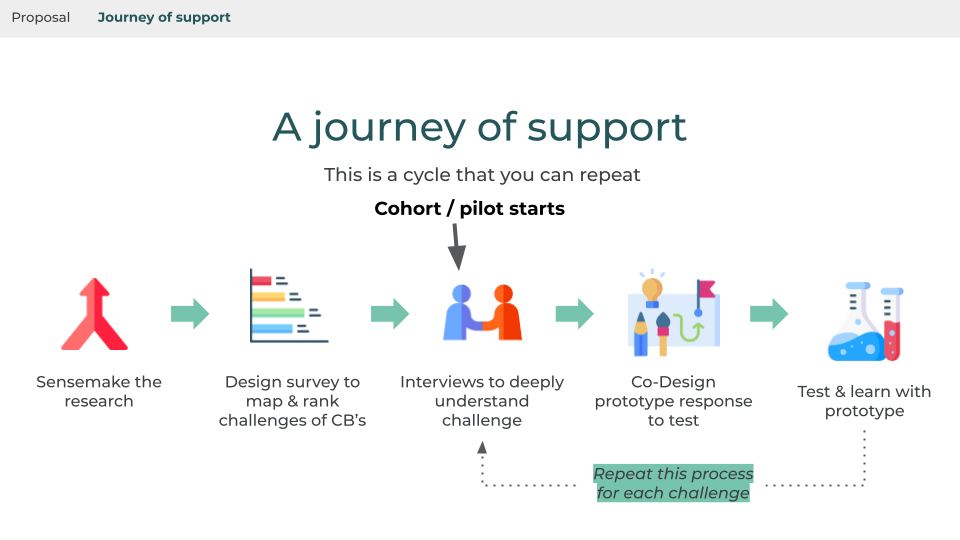
I developed a path and design framework for the team to follow.
Read moreShow less
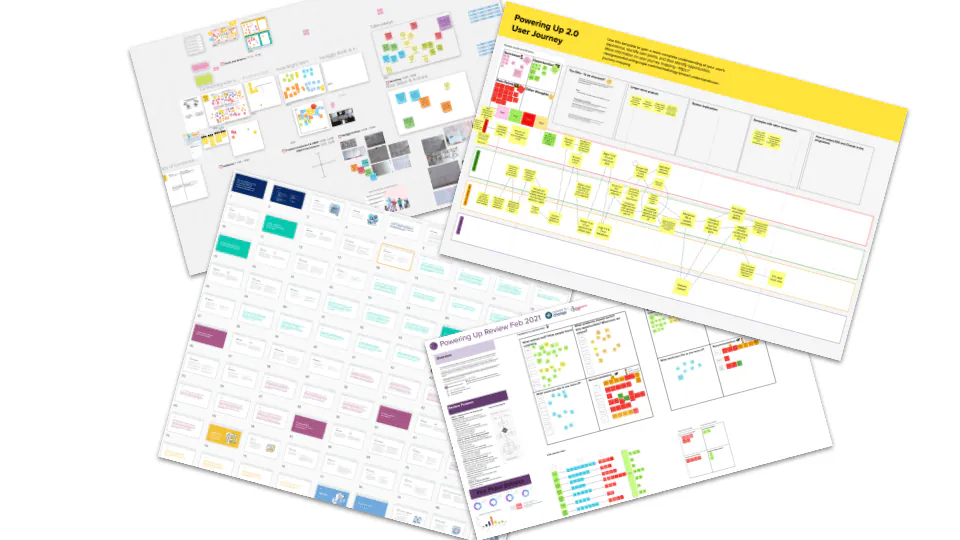
After reviewing the research and activities conducted to date, a broad range of audience challenges was clear. However, the insights didn’t have the depth needed to innovate on specific issues or provide a sense of where to start. Not having a clear problem or starting point was essentially why the team had struggled to move forward.
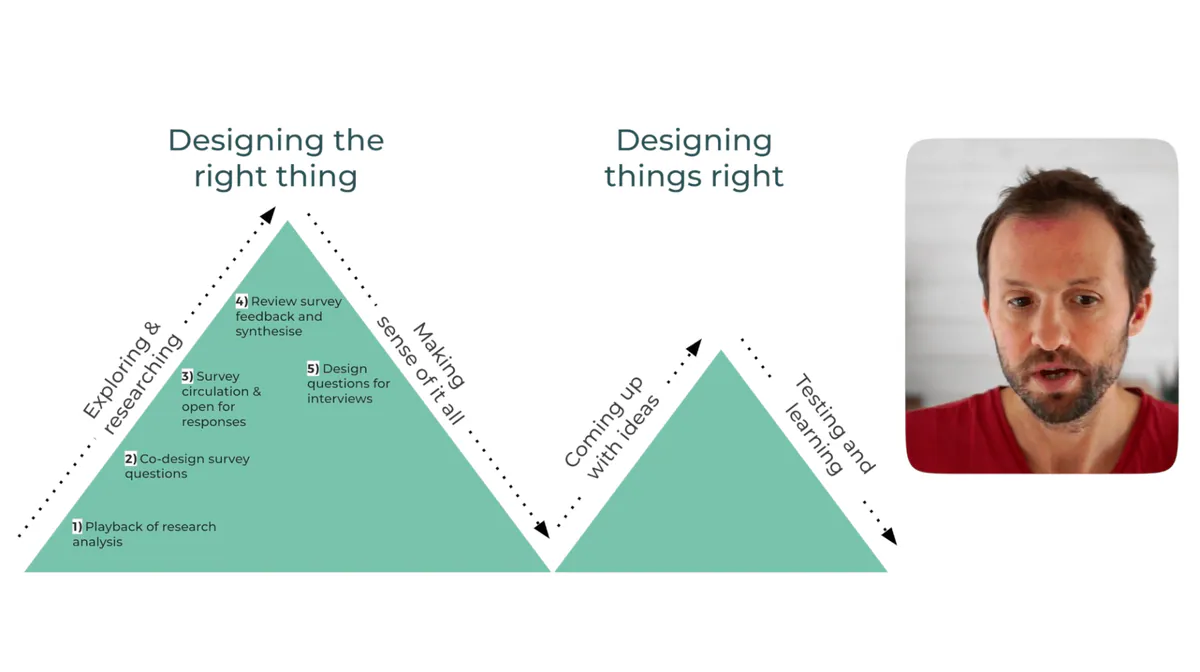
Sharing the ‘double diamond’ approach Un-boiling the ocean of research
The first task was to ‘un-boil’ all the research done to date and establish some priorities of where to focus on first.
Read moreShow less
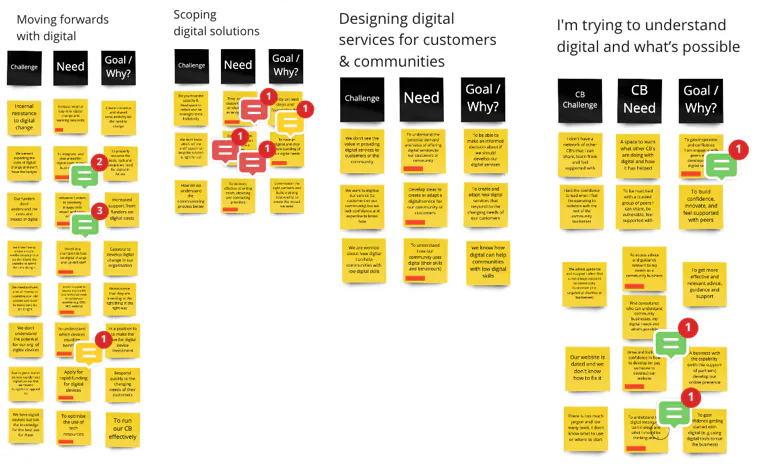
To synthesise the research, we collated insights into high-level user needs split into three headers;
User Challenge | User Need | User Why?
This provided a quick and actionable way the group could absorb the research and validate it based on their understanding of the users. 4 theme’d areas begun to emerge.
Understanding where to focus on first
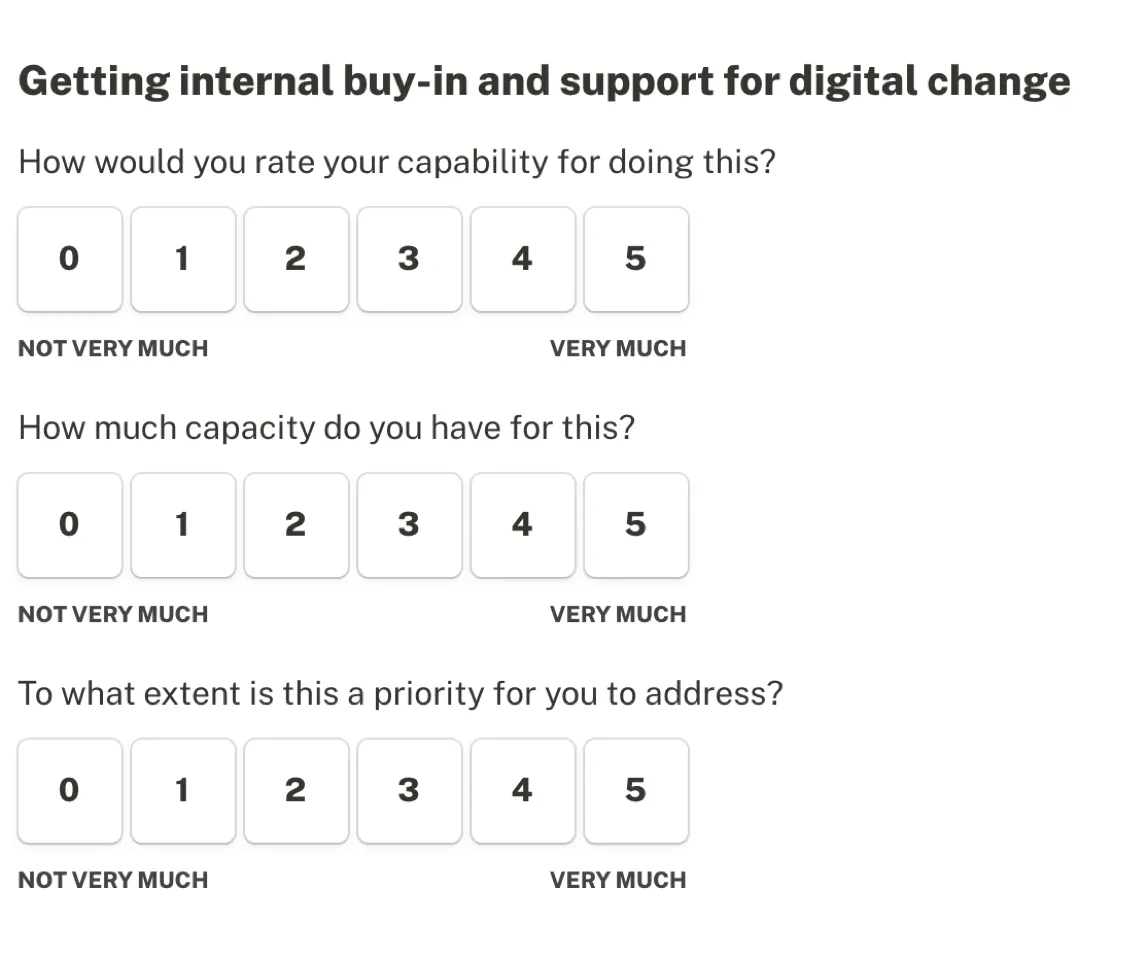
It was important to understand where to focus on first, so we developed a survey using the theme’d insights.
Read moreShow less
A method out of the Jobs To Be Done playbook that connects qualitative and quantitative data that we updated for the funder and community business sector.
We created the survey based on each high-level user need with three measures. Allowing us to view the user needs to be ranked by understanding ;
- Capability to resolve user need
- Capacity to resolve user need
- Level of importance
Ranking and prioritising
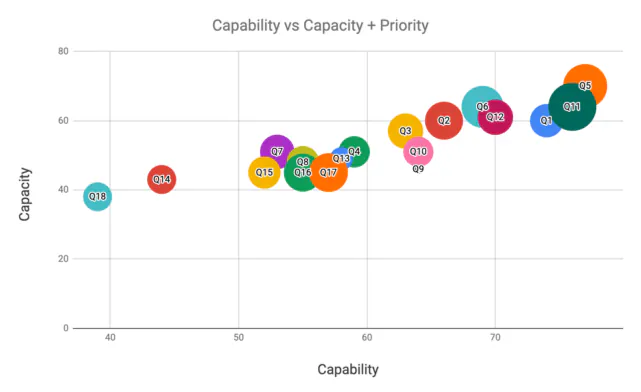
We mapped the survey results using a bubble diagram to visualise where to the most viable opportunities were.
Read moreShow less
The size of the bubble indicates importance level and positioning showing the level of capacity vs importance. The team now had a data driven approach and confidence to prioritise their effort and focus.
Going deeper into one area
What emerged as the most important and that the community businesses had the least capacity for was ‘Finding time, space and support to reflect on what we need as an organisation’.
Read moreShow less
It seemed that community businesses were struggling to articulate their needs without having space and time to consider how to answer that question. Having prioritised our first area of focus allowed the team to create a research plan to go deeper.
To innovate for this problem, we needed to understand it in more detail. We agreed that user interviews would be a valuable method to learn and understand more. The team created an interview template and interviewed a range of participants (sourced from the clients existing relationships).
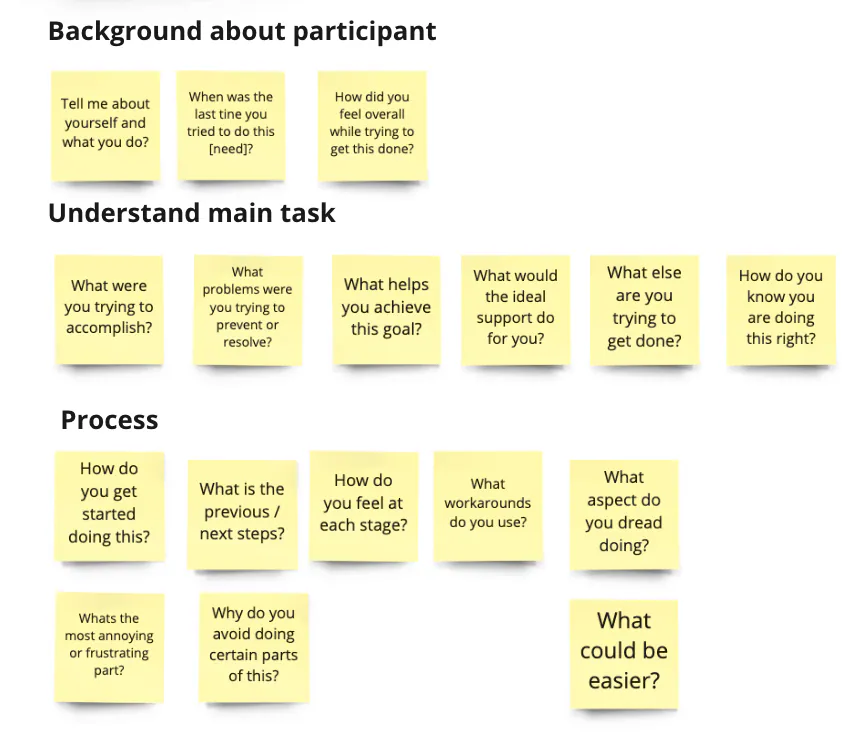
Sense making the interviews
To create a shared understanding between the team based on all the interviews, we held space to share, discuss and capture themes and patterns that emerged.
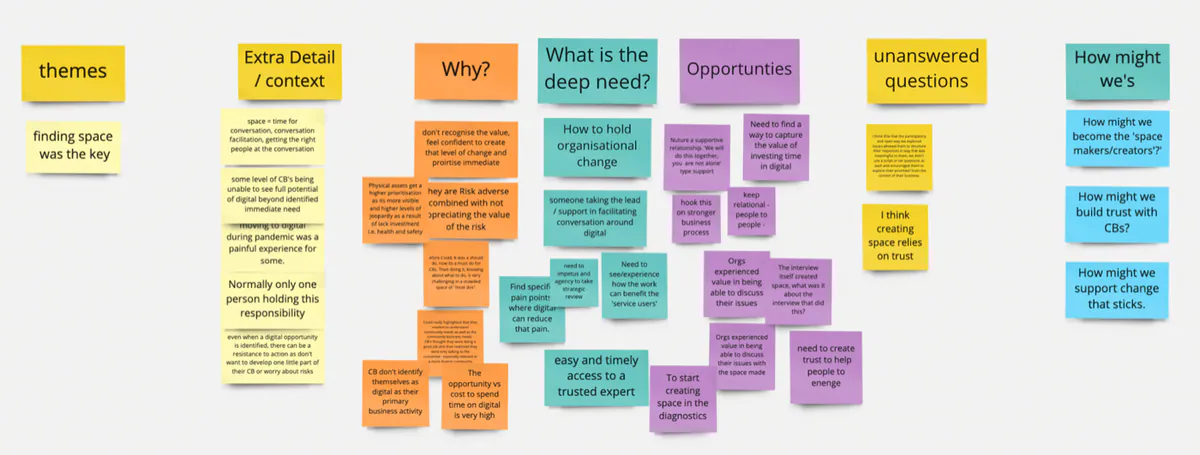
Read moreShow less
Interestingly the community businesses reported that even the process of having the interview felt helpful in creating a bit of space to think.
Problem statements
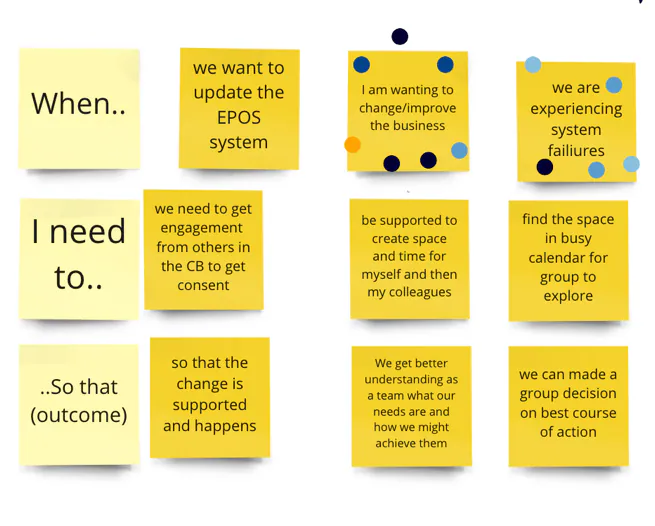
The group attempted to create a problem statement that summarised their understanding to focus on the insights.
Read moreShow less
It took a few go’s to get it right, the team initially going too granular in their thinking. The group voted on the final statement based on the best representation of their understanding to date.
Ideation around different themes
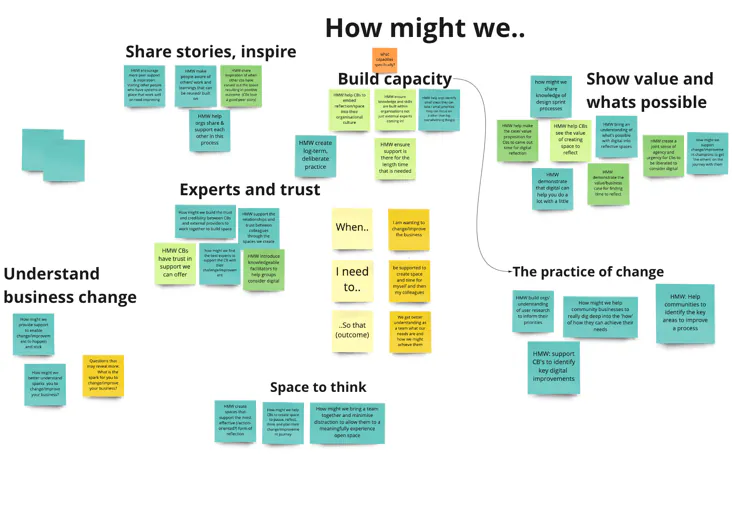
Bringing together the collective wisdom and group discussion, we generated several ‘How might we..’ statements..based on the opportunities we could see.
Read moreShow less
HMW statements gave the group permission to try lots of ideas and focus on the opportunities rather than solutions.
Sketching
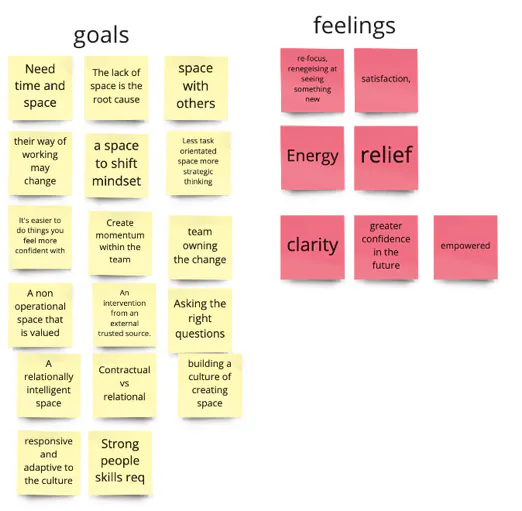
Having voted on a collection of HMW statements, we created clear goals and outlined the users’ feelings when using the service.
Read moreShow less
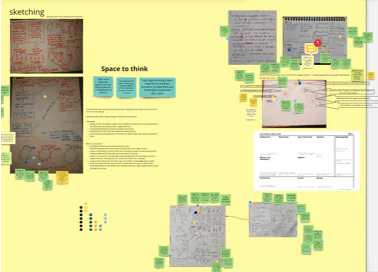
We were aligning as a group around intent and design outcomes. The team built on the conversations and transitioned quickly to this stage when sketching and visualising their ideas. The sketches hand-drawn where photographed and imported into the board.
Prototyping and next steps
The team are now entering a new phase of prototyping a different kind of support for community businesses. One that is focused on giving space to think.
Read moreShow less
The next challenge will be to develop a support programme prototype that validates the assumptions made without becoming too big to fail.
Final reflections
Initially, I felt a little overwhelmed skimming through the 100-page report and seeing the large amounts of work done to date. Later on, by reflecting on the different modalities of a design journey to ‘converge’ or ‘diverge’ was very helpful for me. The group could see that the reason it was overwhelming was that they had tried to converge and move into an ideas phase too quickly. We needed to spend time sensemaking and aligning on the research done to date. Using the Jobs to be done survey method was really effective for this.
The sessions themselves still required patience and guidance to keep the group from jumping to ideas and converging (jumping to the second mountain) too quickly. It can be an uncomfortable place to be, where it feels like we are drifting and endlessly discussing things. However, what was actually happening was that the team were forming a strong consensus about what the problem is. This group consensus was key to developing and innovating in the ideas phase in an effective way.
The challenge of the team’s limited availability was overcome well with the thoughtful use of different collaborative spaces and tools. They came together in collaborative sessions and discuss and then worked more effectively offline until the next meeting.
Towards the later stages of the journey, it was wonderful to see the group gaining confidence in both the process and the ideas being created.
An innovation-friendly culture I think the culture of the team wanting to deeply listen to each other served them well in what can easily become a process that only the loudest voices are heard. It was a delicate balance to strike between behaviours of consensus vs the speed and excitement of developing an idea.
The patience paid off as it bought the team to think deeply about a really about a very simple, compelling and important problem; supporting organisations to find, create and hold space to think about their priorities.
I got so much from the 2 hours I was able to come along yesterday — thank you for some great facilitation @Danny Hearn and also just want to notice the value of doing the slower and deeper research. The depth and colour we were able to understand and talk through about what the CBs might really need was fabulous.’
Thank you for some great facilitation and also just want to notice the value of doing the slower and deeper research. The depth and colour we were able to understand and talk through about what the CBs might really need was fabulous.