NHS · Service design · User research
Mapping an NHS Sexual Health Service
I supported Manchester NHS Sexual Health Services in co-creating insights and recommendations to improve care for trans and gender diverse (TGD) people. Working collaboratively with NHS practitioners, service leads, and service users, I co-facilitated a process that ensured lived experiences and professional perspectives shaped meaningful service improvements.

- Client
- Manchester NHS sexual health
- Agency
- DOT Project
- Duration
- 2 weeks
- My role
- Co-facilitator (alongside Alex Mecklenburg), User Researcher
- Activities
- User Research, Facilitation
My impact
Before
The Manchester NHS sexual health service lacked clarity & deep understanding on how to improve the service.
What I did
Facilitated trauma informed journey mapping workshops with system of policy managers, clinicians, and service users.
Results
- Service further developed the service drawing on actionable and prioritised problem statements.
- Clinician team had deeper understanding and empathy for service users.
- Service users felt heard and part of the process.
The challenge
The NHS sexual health service in Manchester recognized the need to enhance the quality of care for the trans and gender diverse (TGD) community. Acknowledging the importance of co-design, they committed to improving services in collaboration with the TGD community to ensure more inclusive, responsive, and effective healthcare.
Our challenge was to gather meaningful insights from a diverse group of health practitioners and TGD service users. Facilitating discussions across such a broad range of participants required a careful, inclusive approach—creating a space where all voices felt heard and valued while navigating the complexities of healthcare experiences and perspectives.
Creating a safe enough space
Creating a safe enough space in this context meant fostering an environment where both TGD service users and health practitioners felt able to share openly—acknowledging that absolute safety is complex, especially in discussions about healthcare experiences.
We focused on setting clear facilitation agreements, using trauma-informed approaches, and balancing structured dialogue with open reflection. By recognizing power dynamics, validating lived experiences, and ensuring participants had control over their level of engagement, we built a space where trust, honesty, and meaningful collaboration could emerge.
Mapping the journey
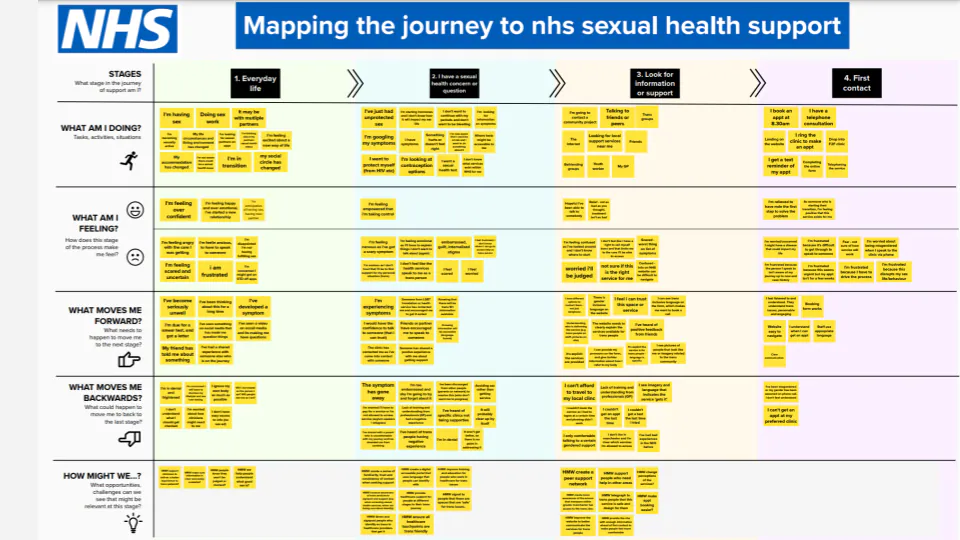
Through thoughtful facilitation we used a journey map - a visual map of the journey from the perspective of the user - as a tool for capturing and framing discussion around the experience of a service.
Themes and voting
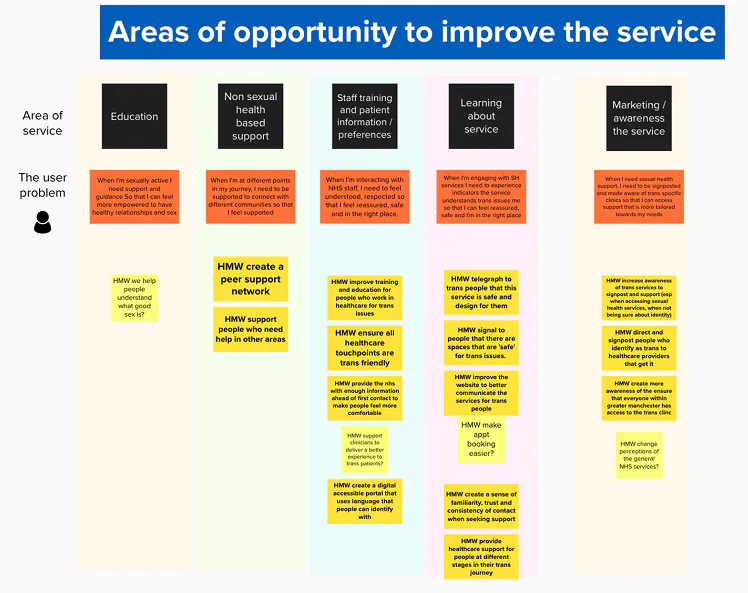
By identifying HMWs from the board we were able to collate them into themes. This helped the group distill the vast information collected into 5 areas of opportunity
Problem statements and HMWs
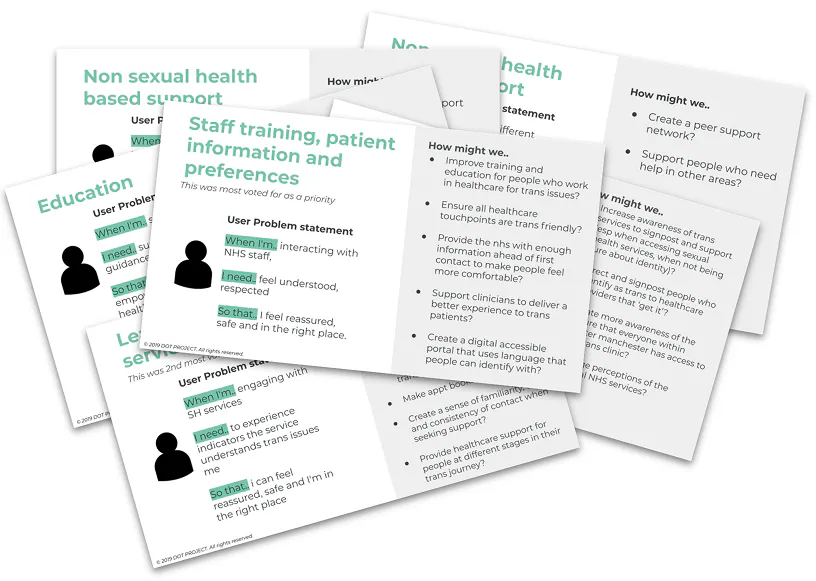
Using the journey map input we synthesised the data into problem statements and How might We’s.
This format gave the NHS team a practical and actionable outcome of the activity and input from the participants
Final reflections
Breaking the Ice
During our initial alignment sessions, engagement was low, with only one or two participants speaking out of a group of 15+. To encourage participation in my first design session, I started with small breakout groups, which helped break the ice. This approach made a noticeable difference—more participants turned on their cameras and engaged in discussion, creating a more open and interactive space.
The Format
Using a journey map as a facilitation method proved highly effective for gathering insights and sparking meaningful conversations. The two key prompts—“What would move you forward?” and “What moves you backward?”—helped participants articulate their experiences and identify actionable opportunities for improvement.
Practical Considerations
Rather than allowing participants to work directly on the board, we opted for a transcribing approach due to varying levels of tech confidence and the types of devices being used. While this required more facilitation effort, it ensured that everyone’s contributions were captured and included in the process.